

Calculate the Real Value of a Specialist Scissor
Count useful work, learning, upkeep and whether saved time changes contribution before adding a pair.
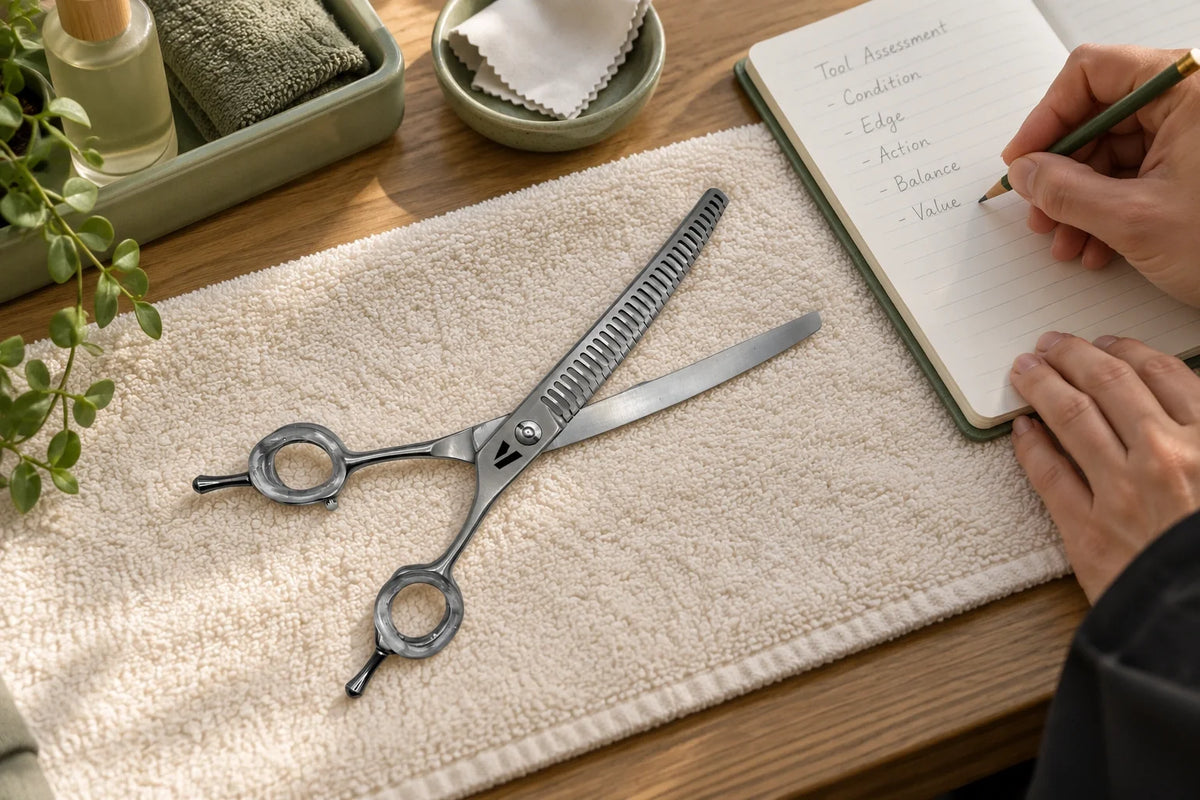
A specialist pair earns its place when it serves recurring work that your present kit does not handle as well. That value may be a more suitable finish, clearer access or less rework. A claim about minutes saved is incomplete until you know whether the time can be used and what the tool costs to own.
Name the recurring job
List the actual task: a rounded contour, a particular blend or controlled volume reduction. Record how often you perform it and what limits the current method. If the main issue is preparation or an unseen working area, a new pair may not resolve it.
The VUNRO Precision Curved Thinners and Precision Curved Chunkers have different tooth arrangements. Their similar length does not make their removal behaviour equivalent. Buy for a named job you are trained to perform.
Separate a useful result from a financial result
First assess whether the pair helps produce the agreed finish safely and comfortably. Then assess time and costs. A suitable quality improvement may be worth retaining even without extra appointments; explain that benefit rather than inventing increased sales.
Conversely, a shorter cutting stage does not necessarily shorten the appointment. Extra setup, cleaning, checking or rework elsewhere can absorb the apparent saving. Measure the relevant full process.
Use a conservative ownership model
List purchase cost, expected servicing, training and any other actual costs over a chosen period. Do not assume a steel grade proves a particular sharpening interval or service life. Use your supplier’s supported care requirements and your own records.
A simple model is: additional contribution from work enabled, plus actual costs avoided, minus tool ownership and learning costs. Avoid counting the same benefit twice. Labour time saved is not an avoided wage cost if the paid shift remains unchanged.
Be honest about released time
As an illustration, four minutes saved on twelve comparable tasks releases forty-eight minutes. It does not prove an extra appointment can be booked. The time may be scattered across days, needed for breaks or absorbed by another bottleneck.
If released capacity supports additional demand, use the contribution from the additional work after its relevant costs, not its whole price. If it improves comfort or schedule reliability instead, record that separately. No VUNRO price or earnings estimate is implied by this example.
Include learning and the alternative
Compare the purchase with supported servicing of an existing pair, a setup change or training. A new tool may have a learning period before its value becomes clear. Plan practice appropriately; do not learn unfamiliar removal behaviour by repeatedly cutting more from a dog.
Where a demonstration or authorised trial is available, keep the task and assessment consistent. Record unsuitable outcomes as well as successful ones. Do not infer a universal improvement from one well-prepared coat.
Make the buying decision finite
Set a review point based on enough relevant uses to assess your actual work. Keep the pair if it serves its named task and the combined benefit justifies its costs. Service, replace or decline where it does not. If evidence is inconclusive, state which task or cost remains unknown.
A specialist kit does not need every available shape. The strongest next pair is the one that performs useful recurring work with appropriate control and a supported ownership case.
Use a break-even example that does not sell you a scissor
Suppose an illustrative purchase, initial servicing and learning cost totals £200. If a genuinely additional bookable appointment would contribute £20 after its variable costs, you would need ten such appointments to recover that initial outlay. These invented figures are arithmetic, not VUNRO prices or a forecast.
Now test the assumption. If the tool saves scattered minutes but creates no extra appointment, those ten appointments have not been gained. Count a real avoidable cost saving instead only if you can show it. Do not count the same time both as reduced paid labour and as extra sales capacity.
Add ongoing care, replacements and uncertainty over the tool's useful work. Compare with your existing tool, servicing or training. A scissor may still be worthwhile for control or a finish it reliably enables, even when its financial return is unproven. State that benefit honestly and set a review point based on relevant use, rather than making the arithmetic promise a profit.
Sources and scope
Lantra’s styling standard supports task-appropriate equipment and professional competence. Product shapes and named materials were checked in the current catalogue. The ownership model and time example are illustrative bookkeeping, not a product trial, promised saving or individual financial advice.
Keep learning
More from the Blade Blog

Choose VUNRO Grooming Scissors for a Named Task
Read the guide →
Which VUNRO Grooming Comb Fits Your Work?
Read the guide →


